
The fly agaric's closest relatives include the most dangerous mushrooms in Europe and North America. The panther cap contains the same compounds in higher amounts, and the death cap and the destroying angels contain amatoxins, which destroy the liver and cause most deaths from mushroom poisoning. This page compares them so that the risk is clear. It is not an identification guide, and nothing on this site should be used to decide that a wild mushroom is safe to eat.
Four species, one genus
All four are Amanita species. They share a basic build: white gills, a ring on the stem, and a base that starts inside a veil. The illustrations below are drawings made for this site, not reference photographs.


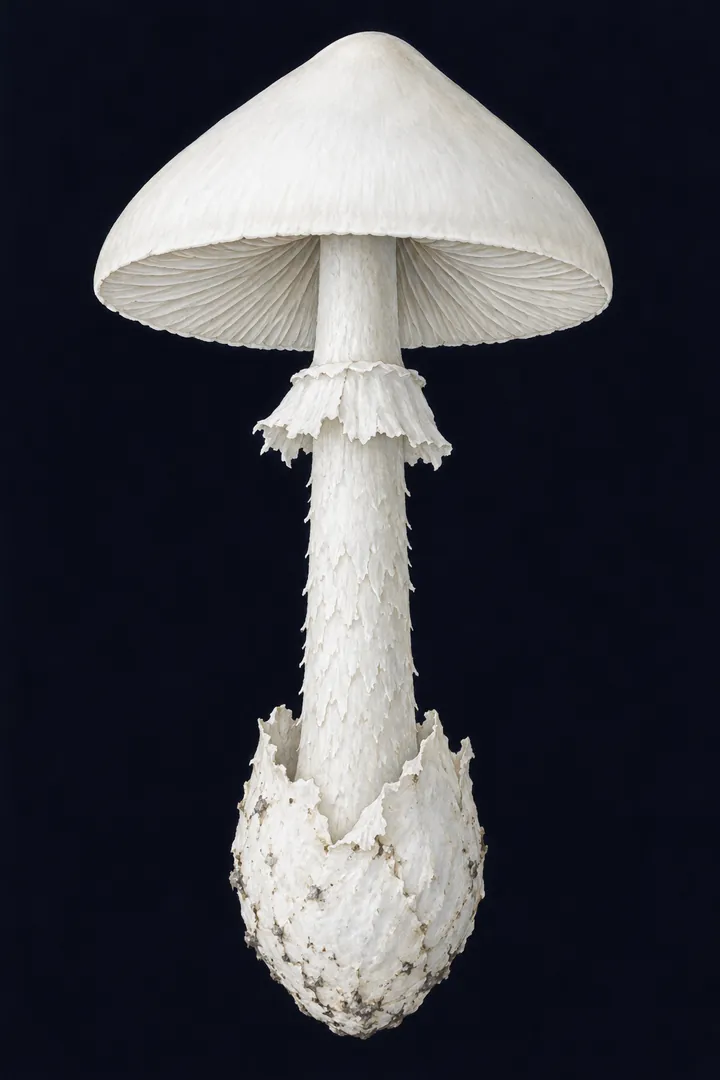
| Fly agaric | Panther cap | Death cap | Destroying angels | |
|---|---|---|---|---|
| Latin name | A. muscaria | A. pantherina | A. phalloides | A. virosa, A. bisporigera, A. ocreata |
| Typical cap | red, also yellow or orange, white flecks | brown, white flecks | olive to yellowish green, sometimes pale or white | pure white |
| Main toxins | ibotenic acid, muscimol | ibotenic acid, muscimol | amatoxins (α-amanitin) | amatoxins |
| First symptoms | usually within 6 hours | usually within 6 hours | after 6 to 12 hours | after 5 to 24 hours |
| What is at stake | intoxication, sometimes severe | stronger intoxication than fly agaric | liver failure, death | liver failure, death |
Sources: Moss and Hendrickson 2019, Wikipedia summaries of the literature on A. phalloides, A. pantherina and the destroying angels.
Panther cap: the same chemistry, stronger
The panther cap has a brown cap with pure white flecks and grows in beech and other broadleaf woods, less often under conifers. It contains ibotenic acid and muscimol like the fly agaric, and it is generally regarded as more toxic.
The clearest numbers come from the Oregon Poison Center, which reviewed every confirmed case reported between 2002 and 2016. Of 34 cases, 23 involved fly agaric and 10 panther cap. The panther cap cases were far more often symptomatic: digestive symptoms in 80% against 35%, central nervous system depression in 70% against 35%, and agitation or other excitation in 70% against 35%. The most serious case in the series was a three-year-old who ate a panther cap and spent three days in intensive care on a ventilator.
In Europe the panther cap is also known for a different mistake: it can be confused with the blusher (Amanita rubescens), a species that people collect for food.
Death cap: the delay is the danger
The death cap is the reason the genus Amanita has its reputation. Its amatoxins block a key enzyme in liver and kidney cells. According to the literature summarised on Wikipedia, half a mushroom can contain enough toxin to kill an adult, and neither cooking nor freezing destroys it.
The course of a poisoning explains why it kills. Nothing happens for 6 to 12 hours. Then come vomiting and diarrhoea, which ease after two or three days. During that apparent recovery the liver is failing, and the damage shows from day three to six. By the time most people connect their illness to a meal, the toxin has done its work. With modern hospital care the death rate has fallen, but liver transplants are still needed in severe cases.
Death caps grow mostly under oak, beech and chestnut. Their cap colour ranges from green and olive to bronze, yellowish or almost white, which makes colour useless as a guide.
Destroying angels: white and deadly
"Destroying angel" is the name for several all-white Amanita species: A. virosa in Europe and A. bisporigera and A. ocreata in North America. They contain the same amatoxins as the death cap. Young specimens, still closed in their veil, look like button mushrooms or puffballs, which is how they end up in kitchens.
Why a picture is no test
Every feature that seems to make the fly agaric easy to recognise can disappear:
- Rain washes off the white flecks, leaving a bare red or orange cap.
- Older caps fade from red to orange or yellow, and some fly agaric forms are yellow from the start.
- The volva, the cup or ring of tissue at the base, often stays in the soil when a mushroom is pulled up.
- A young Amanita still inside its veil shows almost none of its adult features.
Online, the risk adds up: product photos, social media posts and AI-generated images all show idealised mushrooms. None of them can tell you what is in front of you.
If someone may have eaten a wild Amanita
Call for help straight away, even when the person feels fine. With amatoxins the symptom-free hours are exactly when hospital care makes the biggest difference.
- United States: Poison Help, 1-800-222-1222.
- United Kingdom: NHS 111, or 999 in an emergency.
- Netherlands and elsewhere in the EU: 112 in an emergency, otherwise a doctor or out-of-hours GP service.
Keep any leftover mushroom, peelings or vomit, and photograph them. Specialists can sometimes identify the species, which changes what the hospital does.
The effects page covers what happens after fly agaric itself, and the muscimol page explains why fly agaric and panther cap act so differently from the deadly species.
Updated