
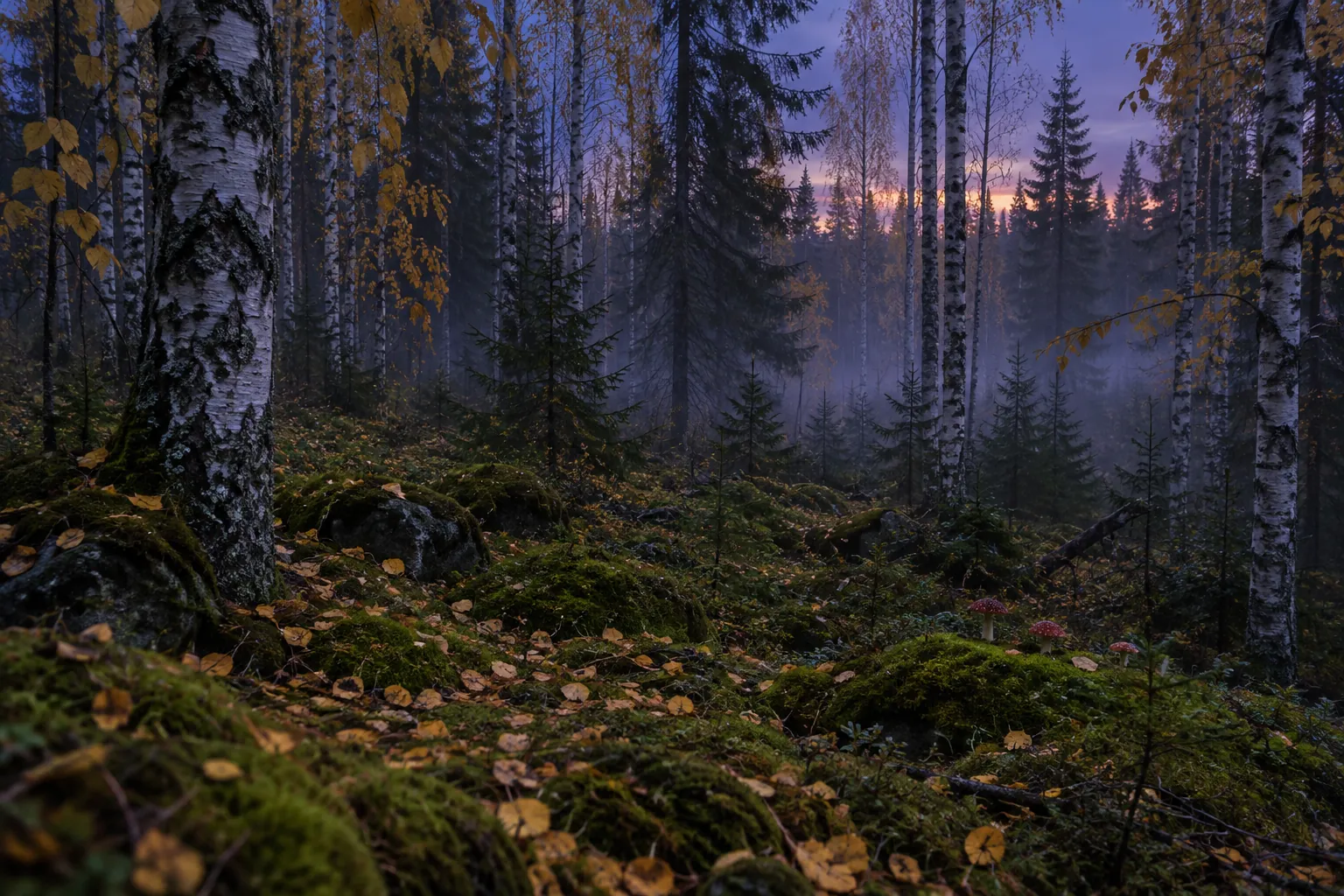
The fly agaric, Amanita muscaria, is the red mushroom with white flecks from fairy tales, and it is one of the most widespread large fungi of the northern hemisphere. It belongs to the genus Amanita, the same genus as the death cap and the destroying angels, which is the first thing worth knowing about it.
What the mushroom looks like
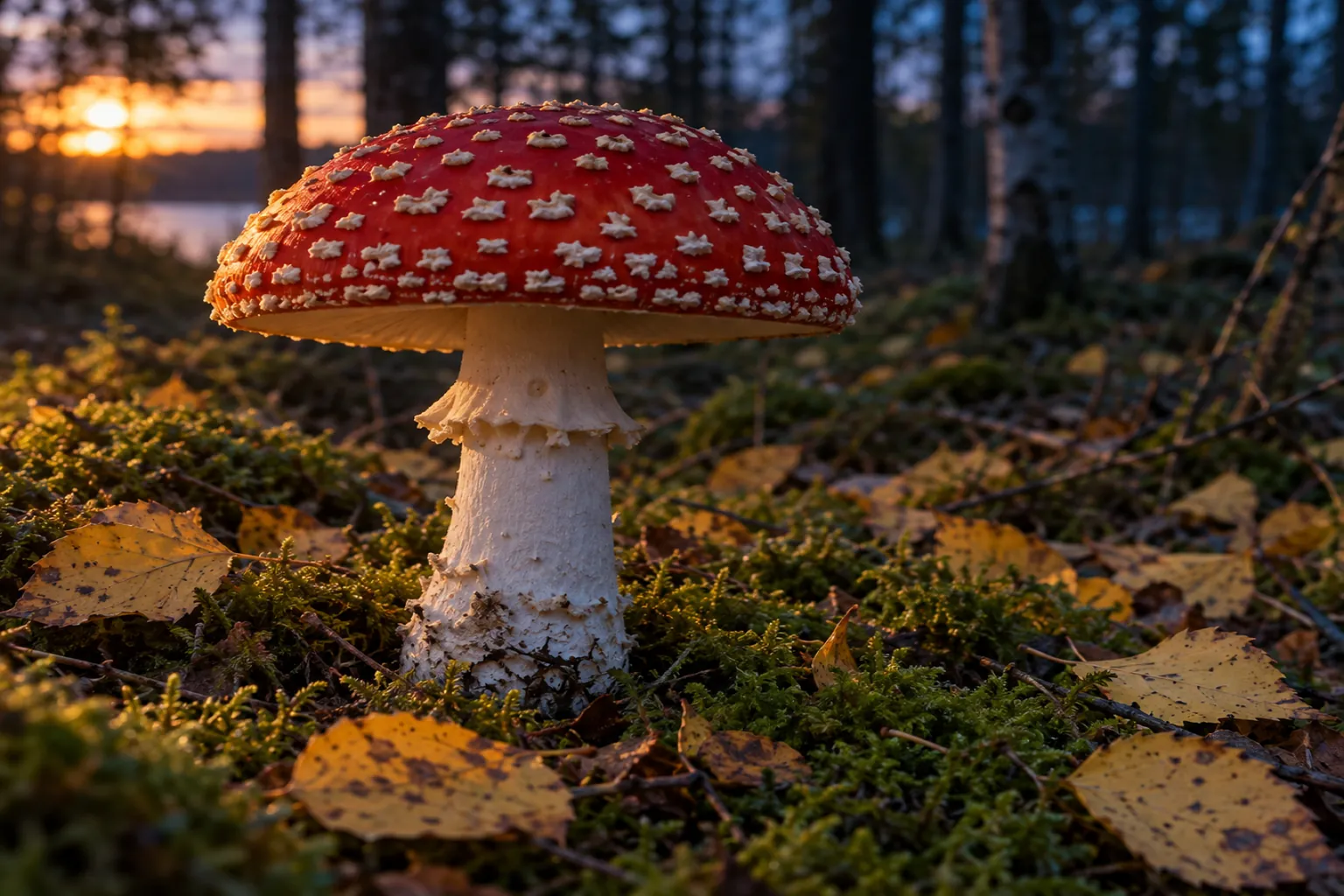
A mature fly agaric has a cap of roughly 5 to 30 cm across, usually bright red in Europe and Asia. The white or cream flecks on top are remnants of the universal veil, a membrane that wraps the whole young mushroom like an egg. As the cap expands, the veil tears into pieces that stay on the surface. Rain can wash them off, which leaves a plain red cap.
Underneath are white gills that do not touch the stem. The stem is white, 5 to 20 cm tall, with a hanging ring near the top and a swollen base ringed with two to four bands of scales. These descriptions follow the field guide of David Arora (1986) as summarised on Wikipedia's species page.
The red is less fixed than most people think. In north-eastern North America the common form is yellow to orange (var. guessowii, also listed as formosa). Along the Pacific coast of America a form with yellowish warts occurs (subsp. flavivolvata). Old or rain-washed caps fade to orange. A "fly agaric" in a photo can therefore look like several other mushrooms, which is why the look-alikes page exists.
Where and when it grows
The fly agaric lives in partnership with trees. Its underground threads wrap around tree roots and trade water and minerals for sugars, a relationship called mycorrhiza. Birch, pine and spruce are its classic partners, with oak, fir and cedar in some regions. That is why it appears in birch woods, conifer plantations and parks with old trees, and seldom in open grassland.
Its native range covers the temperate and boreal zones of Europe, Asia and North America. It has been introduced to Australia, New Zealand, South Africa and parts of South America, where it now fruits under planted conifers. In most of its range it appears from late summer into autumn.
How it got its name
"Fly agaric" and muscaria both point to flies (Latin musca). The oldest written link is from the thirteenth century: Albertus Magnus wrote that the mushroom was powdered in milk to kill flies. Linnaeus named it Agaricus muscarius in 1753, and Lamarck moved it to Amanita in 1783.
The compound muscarine was first isolated from this mushroom in 1869 and was long blamed for its effects. Later work showed the fly agaric contains far too little muscarine to matter. The compounds that do matter, ibotenic acid and muscimol, were only identified in the mid-twentieth century. The muscimol page explains what they do.
Siberian accounts
The best documented use comes from north-eastern Siberia. Eighteenth-century travellers, including the Swedish officer Philip Johan von Strahlenberg (published 1736), described peoples such as the Koryak taking fly agaric. They also described a practice that later writers repeated often: others drinking the urine of someone who had taken the mushroom, because the effects carried over.
Modern chemistry explains why that was possible. Both ibotenic acid and muscimol leave the body quickly in urine, partly unchanged. The accounts are second-hand, written by outsiders, and say little about how often people became ill. They are a historical record, not a recommendation.
The soma hypothesis
In 1968 the banker and amateur mycologist R. Gordon Wasson published Soma: Divine Mushroom of Immortality. He argued that soma, the sacred drink of the Rigveda, was made from the fly agaric. He pointed to verses that describe soma without leaves, roots or seeds, to the colour word hári (translated as dazzling or flaming) and to a passage about soma being urinated.
The idea became famous, but it never became settled. The Sanskrit scholar John Brough answered in 1971 that the verses are too vague to identify any plant. Other researchers have proposed Ephedra, among other candidates. It is fair to call soma-as-fly-agaric a hypothesis that remains open, and nothing more than that.
Folklore and popular theories
Several stories travel with the fly agaric online. Some have a basis, many are guesses.
| Story | What the record shows |
|---|---|
| Berserkers used it before battle | First suggested by Samuel Ödmann in 1784; no source from the Viking age mentions it. |
| It inspired Santa Claus | A modern theory; Sámi scholars reject any link with Sámi culture (Campbell, 2023). |
| It inspired Alice in Wonderland | Mordecai Cubitt Cooke had described size distortion after fly agaric; whether Lewis Carroll read it is unknown. |
| It kills flies | Recorded as household use since the thirteenth century. |
The fairy-tale image is the most lasting legacy. The red-and-white mushroom appears on Christmas cards, garden gnomes and children's books across Europe, which may explain why so many people underestimate it.
Common, cultural and poisonous
The fly agaric is a common, recognisable and deeply cultural mushroom. It is also poisonous, it varies widely in strength, and it shares its genus with the mushrooms that cause most deaths from mushroom poisoning. Read on about what the trip is like, the composite trip reports and the legal status where you live.
Updated